 ChromoDB continues to grow as an open and curated resource for plant chromosome counts, but recent work has focused not only on adding new records, but also on improving how the database is discovered, explored and cited.
Several updates have been introduced to make ChromoDB more useful for both users and search engines. Individual record pages now display more informative titles and descriptions, highlighting the accepted taxon name, chromosome count, country and bibliographic source whenever available. This should make record pages clearer for users and more meaningful when discovered through web search.
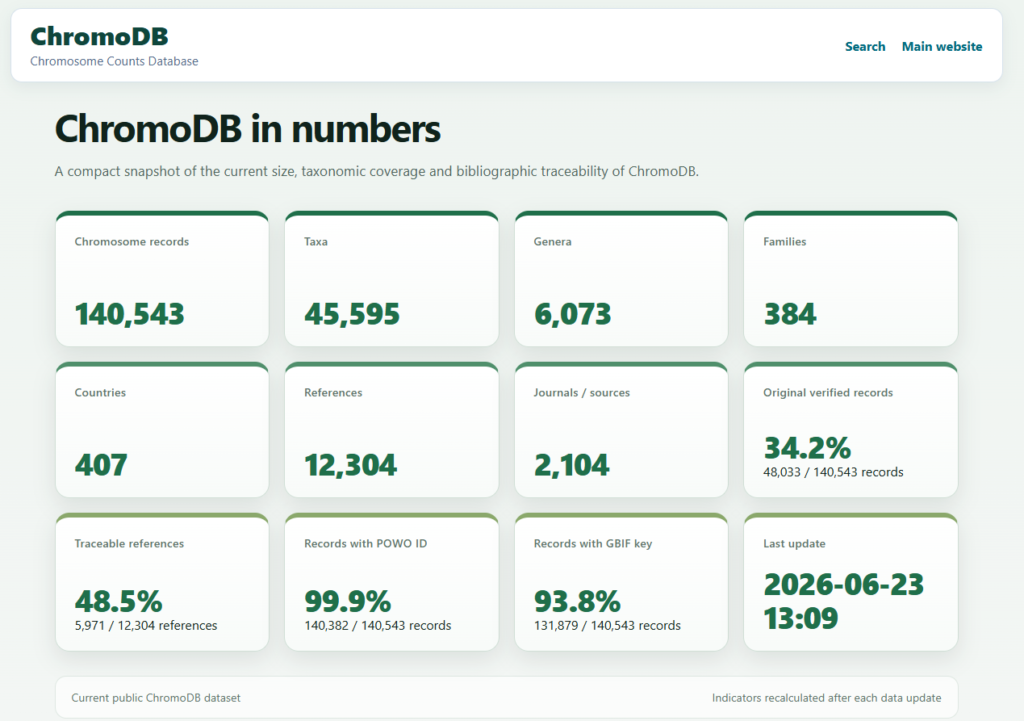
The ChromoDB dashboard has also been improved with direct navigation to the search interface and the main website. The dashboard provides a compact overview of the current public dataset, including the number of chromosome records, taxa, genera, families, countries, references, journals or sources, and indicators of taxonomic and bibliographic traceability.
ChromoDB has also been reinforced in academic visibility channels. The project is now more clearly represented in professional profiles, and the SEBOT2025 poster on ChromoDB has been added as a featured research item in ResearchGate. This poster presents the conceptual framework of ChromoDB and uses the journal Lagascalia as a pilot case study to illustrate the workflow from data extraction to taxonomic standardization, bibliographic linkage, quality control and public dissemination.
At present, ChromoDB includes public search tools, detailed record pages, summary dashboards and a Zenodo community with citable source datasets and partial releases. A global DOI for the full integrated ChromoDB dataset may be considered in a future stable release, but current efforts remain focused on curation, validation and progressive publication.
Explore ChromoDB: https://chromodb.net
Search the database: https://database.chromodb.net/
Dashboard: https://database.chromodb.net/dashboard/