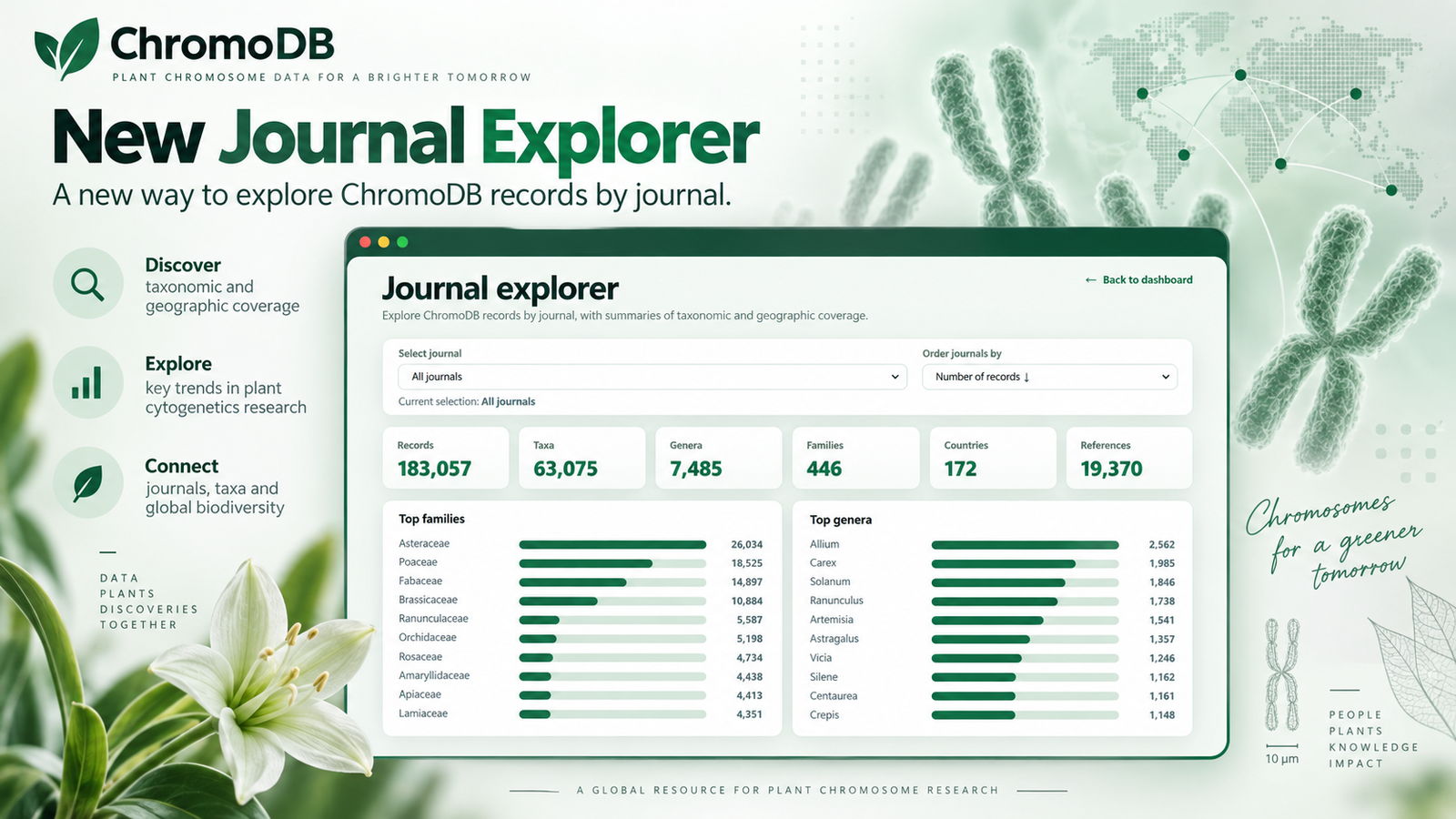
 ChromoDB has introduced a new Journal Explorer, together with a substantial revision of the bibliographic data supporting the database.
The new explorer allows users to examine chromosome records according to the journal in which they were published. For each journal, the dashboard provides an immediate overview of the number of chromosome records, taxa, genera, families, countries and references represented in ChromoDB, together with the most frequently represented families, genera and countries and the distribution of confidence levels.
To keep the visual summaries informative, the journal selector currently includes journals represented by at least 25 chromosome records in the public database. Journals can be ordered either by the number of ChromoDB records or alphabetically.
The Journal Explorer complements the existing ChromoDB in numbers dashboard, which provides a global snapshot of the database. A new dashboard landing page now gives direct access to both tools.
This development has been accompanied by an extensive revision of the BIBLIOGRAFIA_ChromoDB table. Bibliographic records have been progressively cleaned and normalised in order to improve both database consistency and the reliability of the new journal-level statistics.
Among the main improvements are:
- extensive revision and standardisation of
reference_type, distinguishing journal articles, book chapters, conference material, theses and dissertations, books and other types of bibliographic sources; - normalisation of
journal_full, merging numerous spelling variants, historical forms and inconsistent journal names, including many Russian, Japanese and older bibliographic sources; - systematic completion and normalisation of
journal_shortfor records classified as Journal article; - reclassification of records that had previously been incorrectly treated as journal articles;
- improved separation between journals and other bibliographic containers;
- preservation of stable
biblio_ididentifiers throughout the cleaning process.
Following this work, all records currently classified as Journal article have a value in journal_short. Some journal articles still lack complete volume and pagination information, particularly older references for which the original citation contains only author, year and journal. These cases will require individual bibliographic reconstruction and are therefore being addressed separately; they do not affect the operation of the Journal Explorer.
Together, these changes represent another step towards making ChromoDB not only a larger chromosome-number database, but also a more traceable, structured and reusable bibliographic resource.
Explore the dashboards:
ChromoDB in numbers — global database overview
Journal Explorer — journal-level exploration of ChromoDB records